
Pest identification guide
German Cockroaches
Compare adults, young nymphs and egg cases before deciding what to do next. A small cockroach in the kitchen can look very different at each life stage.
Help for homes and businesses across Southwestern Ontario and the 401 corridor.
Recognise the insect
What does a German cockroach look like?
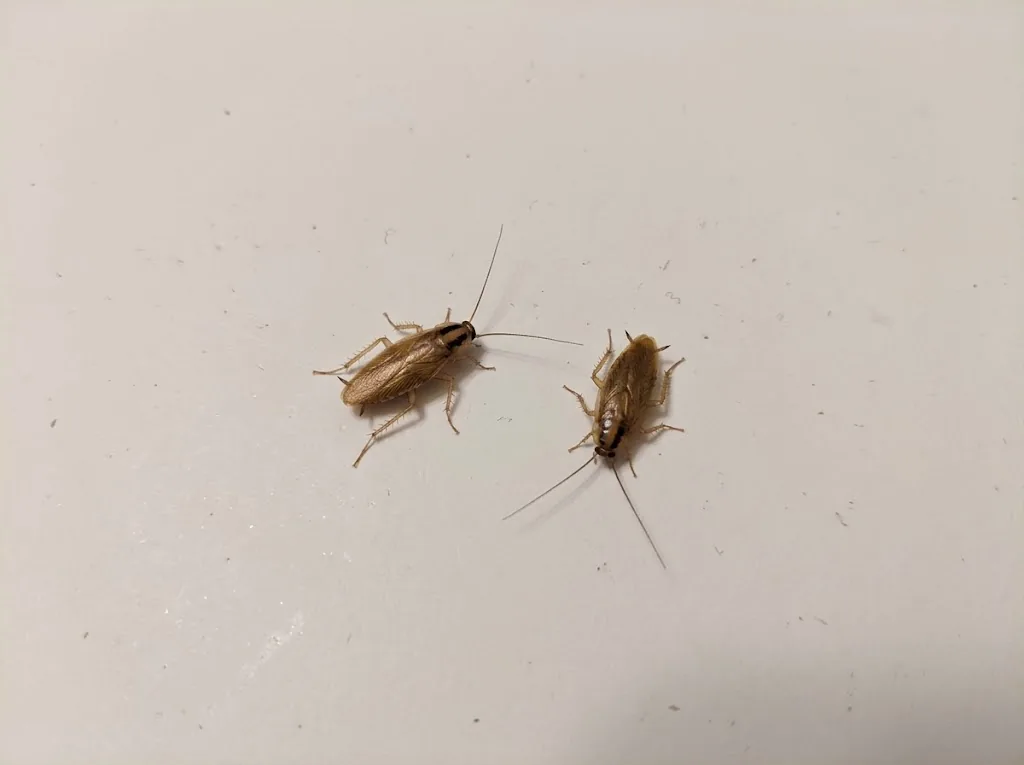
Adults: tan bodies and paired dark stripes
Look at the shield immediately behind the head, called the pronotum. Adults have two dark, lengthwise stripes there, along with long antennae, a flattened body and fully developed wings.
Nymphs: smaller, darker and wingless
Young German cockroaches are darker than adults, often with a pale stripe or patch along the middle of the back or thorax. They grow through several moults before developing adult wings.
Compare several features together. Lighting, an unclear photo or a partly hidden insect can make identification uncertain; a specimen examination may still be needed.
Understand what you are seeing
Life stages of the German cockroach
The life cycle has three main stages: egg, nymph and adult. There is no pupal stage. The illustration shows how the appearance changes as nymphs grow.
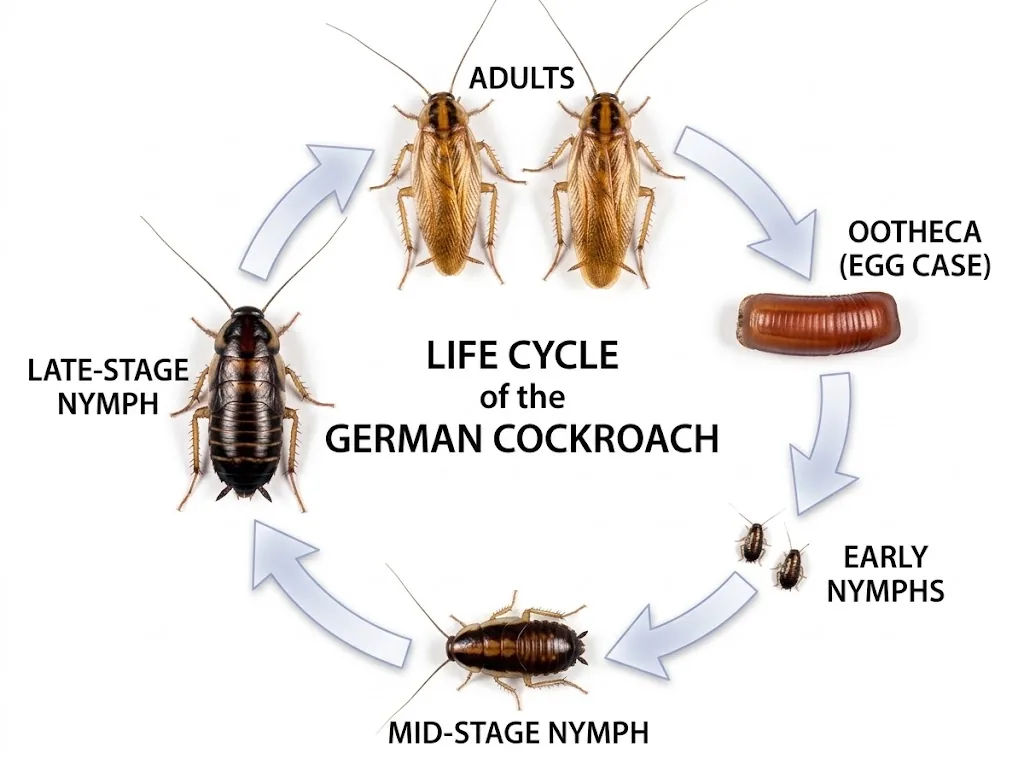
1. Egg case
The eggs develop inside a capsule called an ootheca. The female usually carries it at the end of her abdomen until close to hatching.
2. Growing nymphs
Newly hatched nymphs are small and wingless. Successive moults produce larger nymphs before the final change to adulthood.
3. Adults
Adults have developed wings and can reproduce. Egg cases and small nymphs can be concealed in spaces that are easy to overlook.
Development speed varies with temperature and conditions. A life-cycle estimate is not a treatment deadline: follow-up should assess the activity that remains.
Where to look for signs
Start around food, warmth and moisture. Record sightings, droppings, shed skins and egg cases without dismantling equipment or opening electrical covers.
Kitchen appliances
Check accessible edges behind and beneath refrigerators, stoves and dishwashers, where warmth and food residues can provide hiding places.
Sinks and bathrooms
Look around pipe openings, sink cabinets and plumbing areas. Note leaks or condensation alongside any repeated activity.
Cracks and storage
Inspect cabinet joints and nearby packaging. Small cracks can conceal nymphs even when no adults are visible.
What to do next
Reduce food and moisture
Clean accessible spills and grease, store food in sealed containers, remove rubbish regularly and arrange repairs for leaks.
Track the activity
Keep a record of sightings and existing monitoring results. Monitoring helps identify active areas and assess whether treatment is working.
Plan treatment around the findings
Share the rooms affected and any products already used. Agree on preparation, treatment and follow-up for the property rather than adding products at random.
Cleaning and targeted control work together. Follow your technician’s aftercare instructions around treated areas.
Explore our cockroach-control serviceCommon questions
What do baby German cockroaches look like?
The young are called nymphs. They are smaller, darker and wingless, with a pale marking along the middle of the back or thorax. They do not have the full tan wings seen on adults.
Are cockroach eggs loose or inside a case?
German cockroach eggs develop inside a capsule called an ootheca. The female usually carries the case at the end of her abdomen until close to hatching.
Do German cockroaches have a pupal stage?
No. They develop from egg to nymph to adult. Nymphs grow through successive moults rather than becoming a pupa.
Does a clean kitchen rule out German cockroaches?
No. Cockroaches and egg cases can arrive on packaging, furniture and other objects. Cleaning helps remove resources that sustain them, but their presence does not prove that a property is unclean.
Compare other cockroaches
Sources and further reading
- Penn State Extension: German Cockroaches
Adult identification, egg cases, development and typical indoor hiding places.
- University of Florida IFAS: Assessment-Based Pest Management of German Cockroaches
Nymph markings, inspection, monitoring and treatment assessment.
- Purdue University: German cockroach, photos are rare!
Adult and nymph appearance, incomplete metamorphosis and prevention.
- Health Canada: Cockroaches
Introduction routes, cleaning, moisture management, monitoring and Canadian product-label guidance.
Image credits: the adult photograph and life-stage illustration were supplied for this page by 401 Pest Control. They are not images attributed to the organisations linked above. Sources are provided for further reading, not as endorsements.
General information and safety
Images and descriptions support identification but do not replace a property inspection. Do not select, mix or apply pesticides based on this page. Follow current Canadian product labels and your technician’s preparation and aftercare instructions. Treatment scope and any warranty are confirmed for your property.