
Pest identification guide
Pavement Ants: Identification & Indoor Entry
Small dark ants entering at floor level may be travelling from a nest beneath a slab, rather than living in the cupboard where they find food.
Property-specific help across Southwestern Ontario and the 401 corridor.
Recognise the pest
How to identify pavement ants [1]
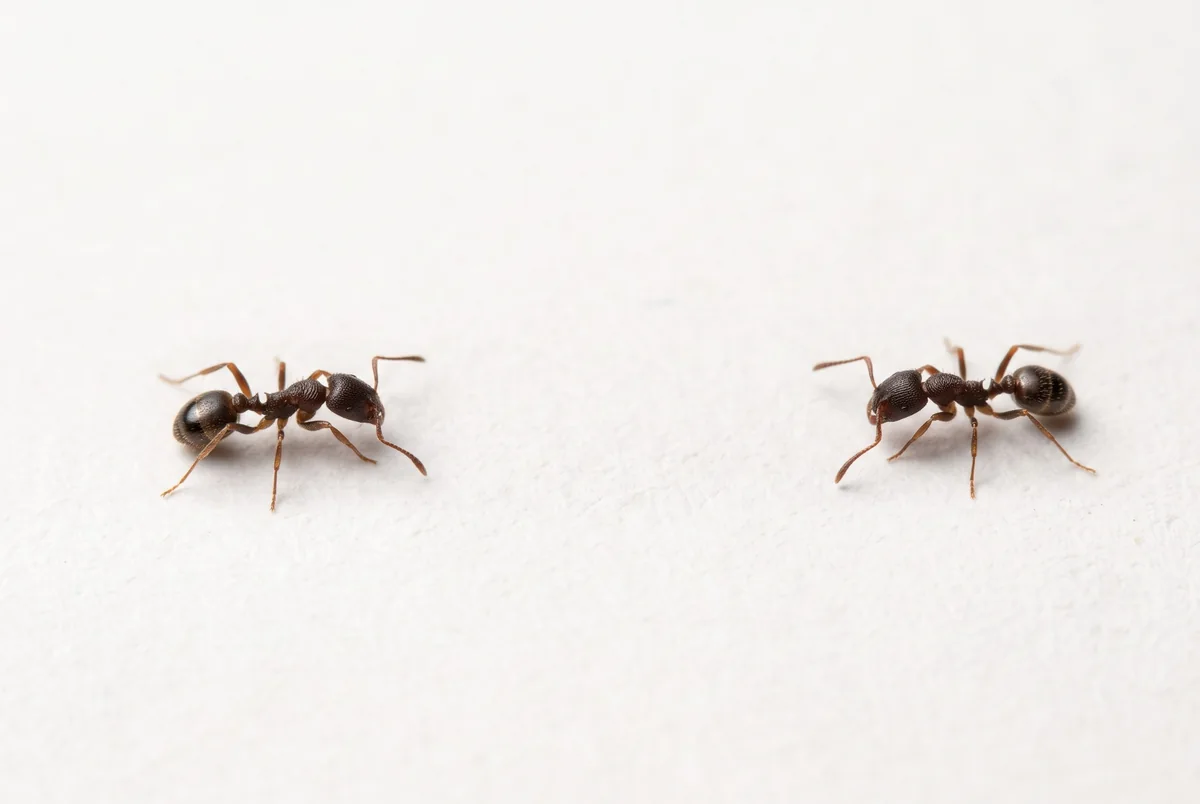
The manual describes pavement ants as brown-to-black ants around 3–4 mm long, with fine parallel lines on the head and thorax. Those small features are not always visible in a phone picture, so colour or the fact that an ant is on a patio should not be treated as confirmation.
Their nesting locations help explain the pattern indoors. Soil beneath slabs, gaps between walls and spaces under patio slabs can support nests. In slab-on-grade houses, expansion joints or the wall-floor junction may provide access from a subterranean nest.
Where to look and what to record [1][2]
Use accessible observations to guide an inspection. Do not disturb a nest, handle an animal or enter a hazardous area to obtain evidence.
Floor and wall junctions
Record repeated entry at the same edge or joint, particularly in a slab-on-grade part of the building.
Patios and slabs
Note nearby ant activity beneath or between slabs without lifting heavy materials or disturbing concealed services.
Accessible food
The manual lists grease and oils as preferred foods, with insects and sweet materials also eaten. Record the food associated with the sightings.
Behaviour and why it matters [1]
An ant seen feeding in a kitchen can have travelled there from a nest below or beside the building. That makes the entry route and surrounding construction relevant to inspection. Treating the kitchen as the only affected area can overlook the connection with soil or slab gaps.
The pavement-ant entry gives nesting and feeding details, not a fixed development time or a universal treatment schedule. A useful plan therefore starts with identification, entry-point observations and monitoring, rather than a promised number of days based only on the name.
An inspection-led approach
Practical next steps [2][3]
These steps adapt the manuals' general integrated pest management (IPM) principles to the pest described above. They are not instructions for selecting or applying a pesticide.
Map the route
Write down the floor joint, doorway or wall edge where the ants repeatedly appear. Include whether activity is also visible outside.
Reduce accessible food
Clean food and grease spills and keep storage areas orderly. These are general sanitation steps from the manuals, not a species-specific pesticide recipe.
Discuss maintenance with treatment
Ask the technician to assess entry gaps and the suspected nest area. Agree which building repairs are appropriate and what signs to monitor after the visit.
Pavement Ants: common questions [1][2][3]
Why are pavement ants coming through a floor joint?
The manual describes nests beneath slabs and access through expansion joints and wall-floor junctions. Repeated sightings there are useful inspection evidence, although identification still matters.
Do pavement ants only eat sugary food?
No. Their entry lists grease and oils as preferred foods, and says they also eat insects and sweet material. Cleaning only one kind of spill may leave other food available.
Are all small black ants pavement ants?
No. Their small size and dark colour overlap with other ants. The fine markings, nesting location and other identifying features should be considered together.
Will sealing one visible crack solve the entire problem?
One opening does not establish the full extent of a nest or all access routes. The manuals recommend identification, inspection, prevention and evaluation together, so repairs should be considered as part of the plan.
Compare related pest guides
Sources and scope
The educational content is paraphrased from the owner-supplied training manuals below. Species information and general IPM adaptations are distinguished throughout. The manuals are not reproduced here, and their publishers do not endorse 401 Pest Control.
- Ontario Pesticide Training and Certification: Structural Module
Appendix A, Biting and Stinging Pests: Pavement Ant. Printed pages A-69, A-70; supplied PDF pages 253, 254. Revision noted in the supplied module: 2020.
Identification, nesting/feeding details, behaviour and species comparisons.
- Ontario Pesticide Training and Certification: Structural Module
Section 3, Integrated Pest Management, pp. 3-1–3-10; supplied PDF pages 31–40.
General inspection, sanitation, exclusion, monitoring and evaluation. Practical next steps are adaptations of these principles, not species-specific pesticide directions.
- Ontario Pesticide Training and Certification: Core Manual
Section 2, Integrated Pest Management, pp. 2-2–2-15; supplied PDF pages 21–34. Section 3, Pesticide Basics, p. 3-18; supplied PDF page 57.
Identification before action, prevention, record-keeping, evaluation and the need to consult current product labels.
General information and safety notice
This guide is not a site inspection, confirmed pest identification, pesticide-use instruction, or medical, veterinary or legal advice. The manuals may not reflect current product approvals or rules. Do not choose, mix or apply a pesticide based on this page. Follow the current product label and your technician's written preparation and aftercare instructions. Avoid disturbing nests, handling wildlife or contaminated material. Treatment scope, timing, follow-up and any warranty are subject to the service terms confirmed for your property.
Help for your property
Talk through the problem before you book.
Tell us what you have seen, where it appears and how long it has been happening. We will discuss the options and confirm the service scope.