Pest identification guide
Carpenter Ants: Signs, Nests & Control
Large ants and sawdust-like debris can point to a nesting problem, but the nest may be somewhere other than the room where you see workers.
Property-specific help across Southwestern Ontario and the 401 corridor.
Recognise the pest
How to identify carpenter ants [1]
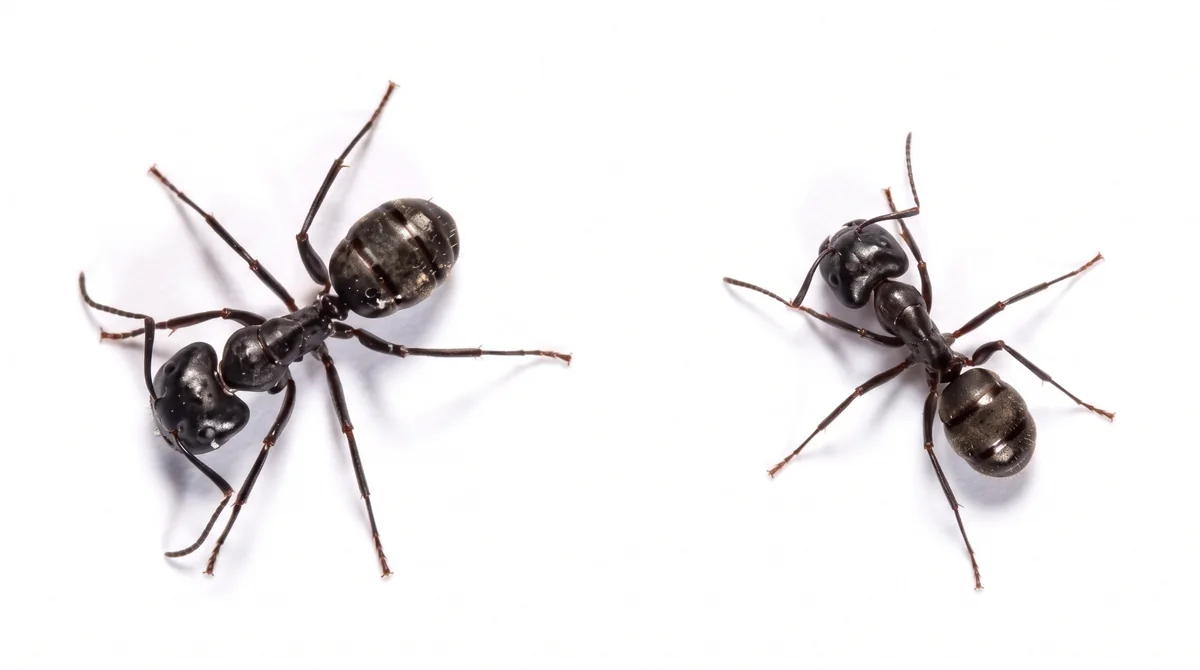
Carpenter ants excavate smooth galleries in wood to make nesting space. They do not eat the wood. The structural manual describes reddish-brown or black workers with large jaws and a rounded thorax; different worker sizes can occur in the same colony.
Sawdust-like material, called frass, can collect where ants eject material from a nest opening. Winged reproductive ants may also be the first visible clue. Neither clue is enough on its own: the manual notes that other ants can nest in decaying wood and produce frass too.
Where to look and what to record [1][2]
Use accessible observations to guide an inspection. Do not disturb a nest, handle an animal or enter a hazardous area to obtain evidence.
Moisture near kitchens
Wood cabinets near dishwashers and other damp building materials can provide nesting conditions.
Window frames and concealed spaces
Check visible activity around damp baseboards, fireplaces, frames, hollow doors and insulation. Hidden areas need suitable access for inspection.
Outdoor wood and possible satellite nests
Decaying stumps, landscape timbers, posts and dead tree wood can support a colony connected to smaller nests inside a building.
Behaviour and why it matters [1]
Workers may forage a considerable distance from the nest, much of it at night. Following the pattern of sightings is therefore more useful than assuming the first ant marks the nest. The manual describes mature colonies producing winged ants and potentially having several satellite colonies in one structure.
Ants can be active in an infested building in different seasons. The manual identifies activity in the middle of winter as a reason to investigate a nest in a warmer interior location. Finding ants does not establish the amount of structural damage; that needs inspection.
An inspection-led approach
Practical next steps [2][3]
These steps adapt the manuals' general integrated pest management (IPM) principles to the pest described above. They are not instructions for selecting or applying a pesticide.
Record activity before changing the area
Note which room, time and opening are involved. Photograph the ants and debris where you found them so the inspection can follow the evidence.
Address moisture, not just visible workers
Include leaks and damp wood in the discussion. Repairing moisture problems and considering both indoor and outdoor nest sites applies the manuals' prevention-first approach.
Agree on an inspection-led plan
Ask what evidence supports the nest location, which areas need access, and how activity will be monitored after treatment. A spray on the ants you can see is not a substitute for locating the problem.
Carpenter Ants: common questions [1][2][3]
Do carpenter ants eat the wood in my house?
No. They remove wood to make galleries, while feeding on insects, plant material and sometimes household food. The resulting sawdust-like debris is excavated material, not evidence that they digest wood.
Does seeing carpenter ants indoors prove the main nest is inside?
No. The manual describes foraging over long distances and indoor satellite colonies associated with an outdoor colony. An inspection should consider both possibilities.
Where should I look if ants are near the dishwasher?
Damp wood cabinets around dishwashers are one location identified in the manual. Note visible trails and moisture, but do not dismantle appliances or building materials just to follow them.
Can you tell how much damage there is from an ant photo?
A photo can help with identification, but it cannot establish hidden gallery size or structural condition. The inspection needs to assess the affected material and extent of activity.
Compare related pest guides
Sources and scope
The educational content is paraphrased from the owner-supplied training manuals below. Species information and general IPM adaptations are distinguished throughout. The manuals are not reproduced here, and their publishers do not endorse 401 Pest Control.
- Ontario Pesticide Training and Certification: Structural Module
Appendix A, Wood Destroying Insects: Carpenter Ant. Printed pages A-107, A-108; supplied PDF pages 291, 292. Revision noted in the supplied module: 2020.
Identification, nesting/feeding details, behaviour and species comparisons.
- Ontario Pesticide Training and Certification: Structural Module
Section 3, Integrated Pest Management, pp. 3-1–3-10; supplied PDF pages 31–40.
General inspection, sanitation, exclusion, monitoring and evaluation. Practical next steps are adaptations of these principles, not species-specific pesticide directions.
- Ontario Pesticide Training and Certification: Core Manual
Section 2, Integrated Pest Management, pp. 2-2–2-15; supplied PDF pages 21–34. Section 3, Pesticide Basics, p. 3-18; supplied PDF page 57.
Identification before action, prevention, record-keeping, evaluation and the need to consult current product labels.
General information and safety notice
This guide is not a site inspection, confirmed pest identification, pesticide-use instruction, or medical, veterinary or legal advice. The manuals may not reflect current product approvals or rules. Do not choose, mix or apply a pesticide based on this page. Follow the current product label and your technician's written preparation and aftercare instructions. Avoid disturbing nests, handling wildlife or contaminated material. Treatment scope, timing, follow-up and any warranty are subject to the service terms confirmed for your property.
Help for your property
Talk through the problem before you book.
Tell us what you have seen, where it appears and how long it has been happening. We will discuss the options and confirm the service scope.